
AquariuMaker
A free library for people who make aquariums, paludariums, ripariums, vivariums, terrariums and jarrariums. Every build is written as an experiment you can repeat: question, materials, method and data.
Each dot is a recipe or an open question. Lines join it to its field and to what it measures. Click a dot to open it.
Show builds for
How a recipe is written
This is the example protocol, built one part at a time as you scroll.
- 1
Question
One question that a measurement can answer.
- 2
Hypothesis
What you expect to happen, written down before you start.
- 3
Variables
Change one thing. Name what you measure. Keep everything else the same in every container.
- 4
Materials
Exact items and amounts, so someone else can buy the same things.
- 5
Method
Numbered steps with times, distances and doses.
- 6
Data
What to record, when, and in which units. The numbers are the result.
- 7
Repeat
One container per group can't rule out chance. Run several per group and compare the averages.
Read the full example protocol
Question
Do live plants speed up the nitrogen cycle in a new container?
Hypothesis
A jar with live plants reaches lower peak ammonia and nitrite, and steady nitrate sooner, than an identical jar with no plants.
Variables
- Changed
- Live plants in jar A, none in jar B.
- Measured
- Total ammonia, nitrite and nitrate in mg/L, every day.
- Kept equal
- Water volume, temperature, light, ammonia dose and jar type.
Materials
| Item | Amount |
|---|---|
| Identical glass jars | 2, about 4 L each |
| Dechlorinated water | 4 L per jar, 8 L total |
| Hornwort (Ceratophyllum demersum), or another fast stem plant that is legal where you live | 6 stems, about 15 cm, jar A only |
| Pure ammonia solution, no scent or detergent | Enough to dose 2 mg/L |
| Liquid test kit for ammonia, nitrite and nitrate | 1 |
| Aquarium thermometer | 2, one per jar |
| LED lamp on a timer | About 800 lumens, 8 h a day |
| Logbook or spreadsheet | 1 |
Method
- Label the jars A and B. Fill each with exactly 4 L of dechlorinated water.
- Put the 6 stems in jar A only. Jar B stays water only.
- Set both jars under the same lamp, 20 to 25 cm away, on a timer for 8 hours a day.
- Add ammonia to each jar until both read 2 mg/L. Stir gently.
- Once a day at the same hour, test total ammonia, nitrite and nitrate in each jar. Record every value and the temperature.
- When ammonia reads 0, dose it back to 2 mg/L.
- Run for 6 weeks, or until a jar takes 2 mg/L of ammonia to 0 ammonia and 0 nitrite within 24 hours.
- On the last day, take the plants out of jar A. Dose both jars to 2 mg/L and test again 24 hours later. This separates what the bacteria remove from what the plants were taking up.
Data to record
| Day | Temp °C | TAN A | TAN B | NO₂ A | NO₂ B | NO₃ A | NO₃ B |
|---|---|---|---|---|---|---|---|
| 1 | |||||||
| 2 | |||||||
| 3 |
TAN is total ammonia (NH₃ plus NH₄⁺), which is what most hobby test kits read. Use the same kit for every reading and write down the units it reports.
The science
Nitrifying microbes turn ammonia into nitrite, then nitrite into nitrate. One group, comammox Nitrospira, does both steps in a single cell. Plants add a second route: they take up ammonium and nitrate directly, and they release oxygen that nitrifiers use.
Reading the result
If jar A shows lower peak ammonia and nitrite and reaches steady nitrate first, the hypothesis is supported. If the two jars track together, it is not. Step 8 shows how much of the difference came from the bacteria and how much from the plants.
Send a recipe
The library is built from what makers send in. A plan is enough to start. Data can come later.
- 1
Pick an open question on the map, or bring your own.
- 2
Send it with this form, with a link to your method, data or photos if you have them.
- 3
I read every submission and check the method. When it's ready, it goes on the map with your name.
- 4
Other makers run it and send their data. Each run is added to the same recipe.
- No likes, follower counts or trending lists.
- Linking your own profile is optional.
- Beginners are welcome. Be precise and be kind.
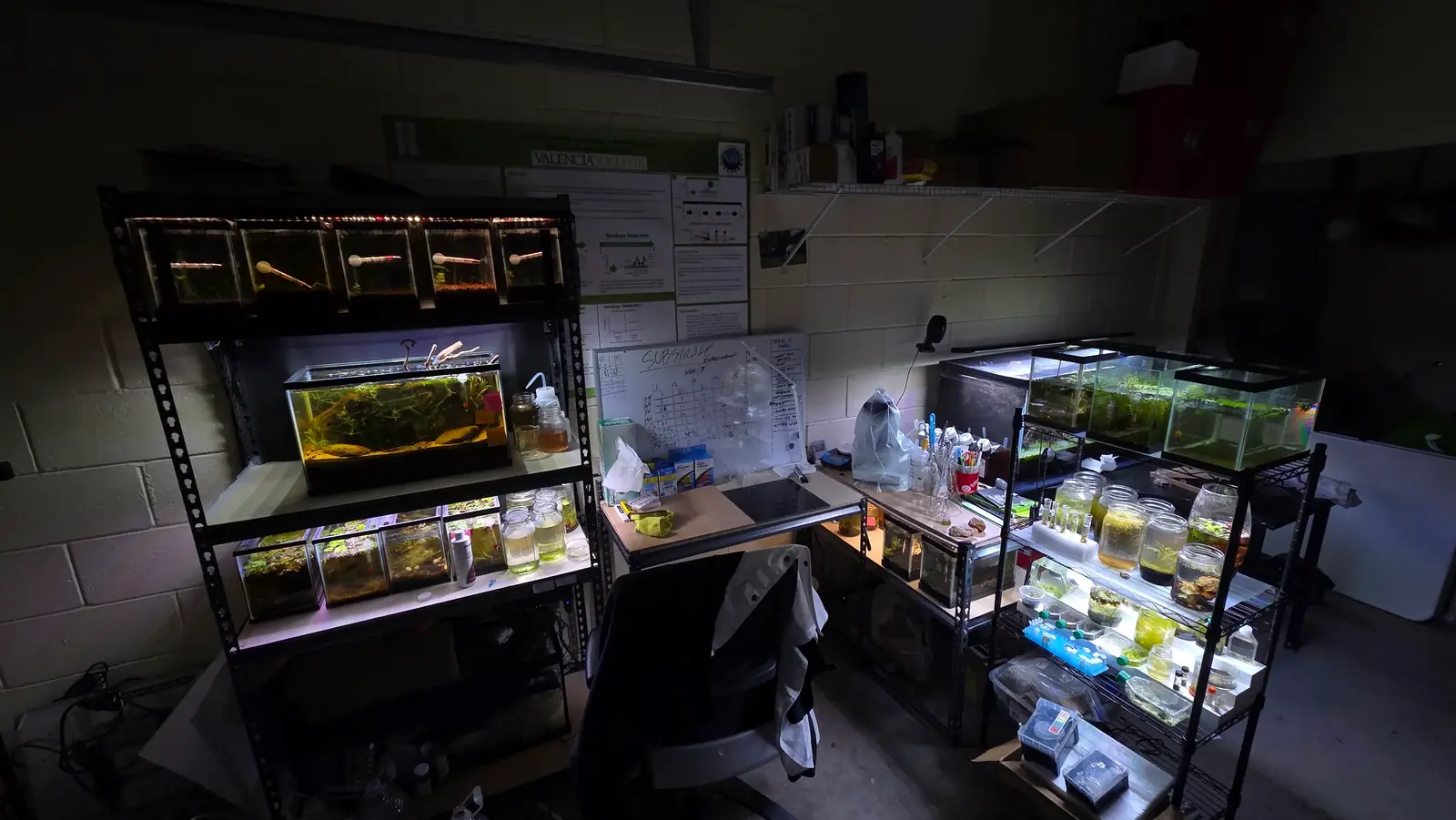
The lab behind it
AquariuMaker comes out of my home lab, where I run planted tanks, culture jars and the Impossible Aquariums experiments. Two of those projects are already on the map.
Support it
No ads and no accounts. If you want to help the library grow:
Run a recipe and send your data.
Send a recipeBuy a kit or the SUBEX report from Impossible Aquariums.
Visit the shopLeave a tip.
Leave a tip